




In October, 26 PhD researchers spent four days writing together at our Autumn Thesis Bootcamp. Between them, they wrote 297,598 words.
That’s an average of 11,446 words each, and the biggest total of any bootcamp we’ve run this year.
Throughout the bootcamp, everyone logs their word count after each sprint and checks in anonymously with how they’re feeling. There’s also an anonymous feed where people can say what’s blocking them, what’s going well and what they keep putting off. I’ve pulled the numbers out of that dashboard below. Everything is anonymous, with no names anywhere.
About 3,300 words a day, every time
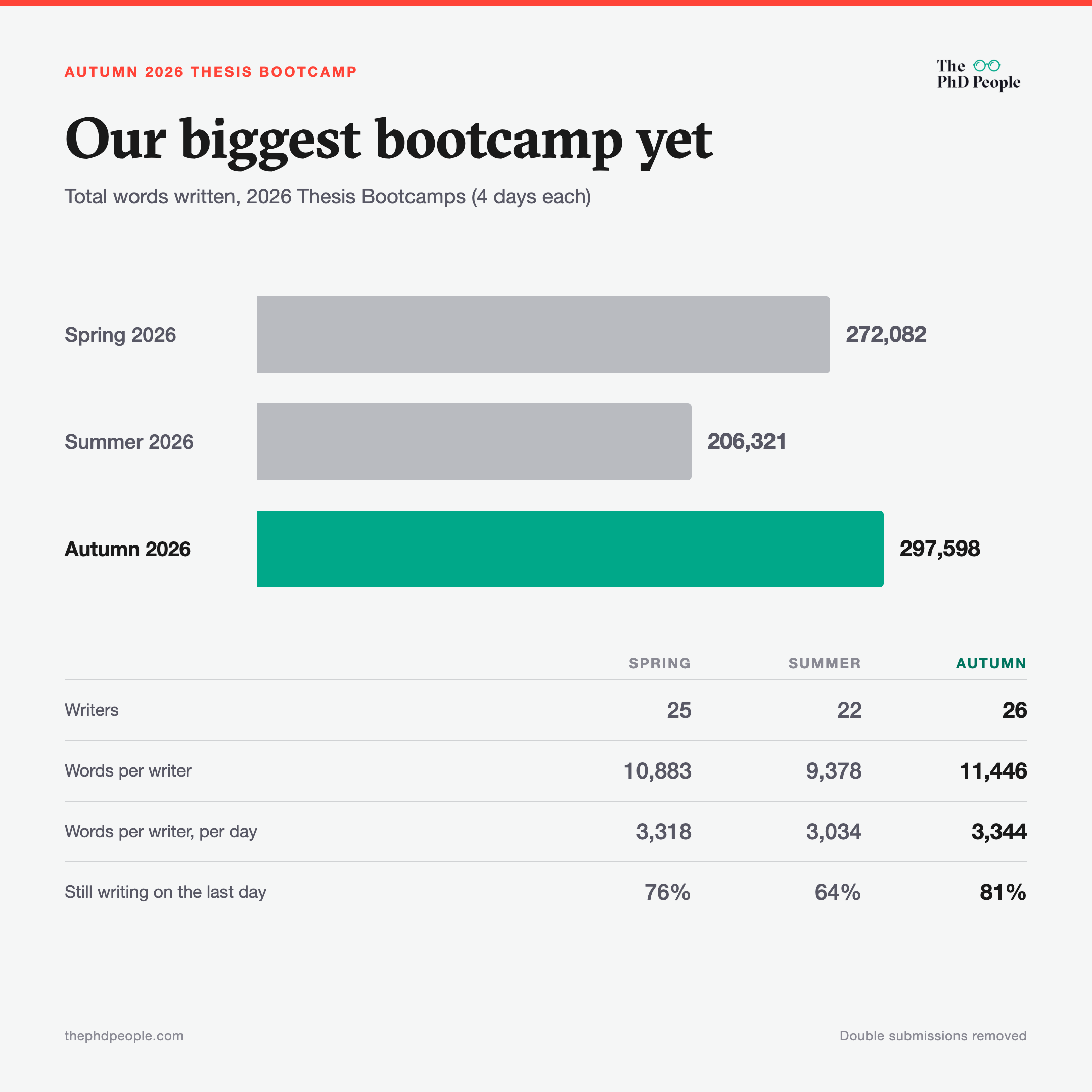
We’ve now run three bootcamps this year with the same structure and the same dashboard. Average output per writer, per day, came in at 3,034 words in Summer, 3,318 in Spring and 3,344 this Autumn.
I find that consistency reassuring. It suggests the words come from the structure: a clear goal, timed sprints and a room full of people doing the same hard thing. Nobody has to be having a good week for it to work.
The hardest day was the biggest one
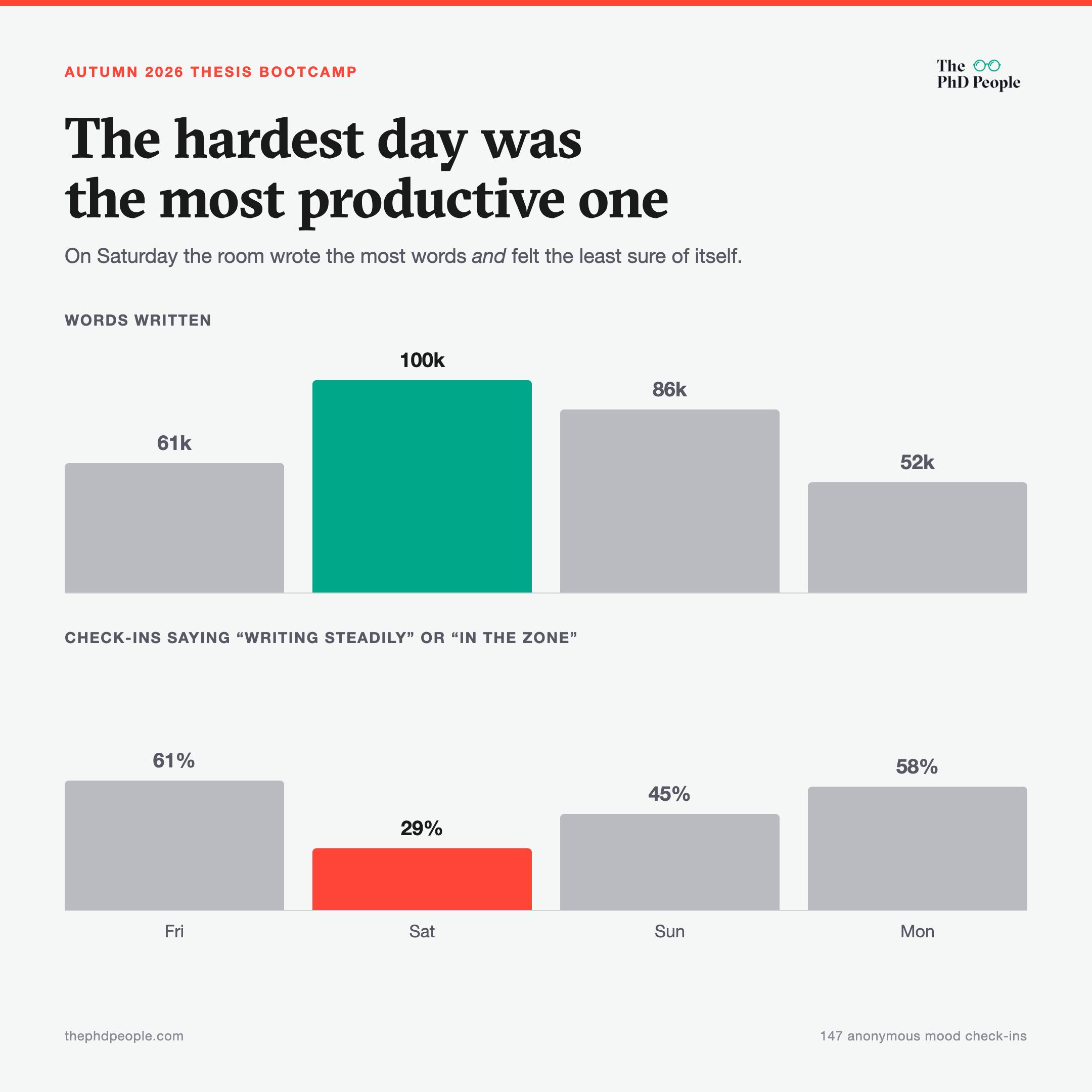
Saturday was the biggest writing day by a distance, with almost 100,000 words. It was also the day the room felt worst. Only 29% of mood check-ins on Saturday said “writing steadily” or “in the zone”. Most people clicked “uncertain”. Our Spring bootcamp followed exactly the same pattern.
To be fair to the data, Saturday is also our longest day, with seven sprints, so some of that total comes from extra hours. But the shape still says something. The day people felt least sure of themselves was the day they wrote the most.
Uncertain is what drafting feels like
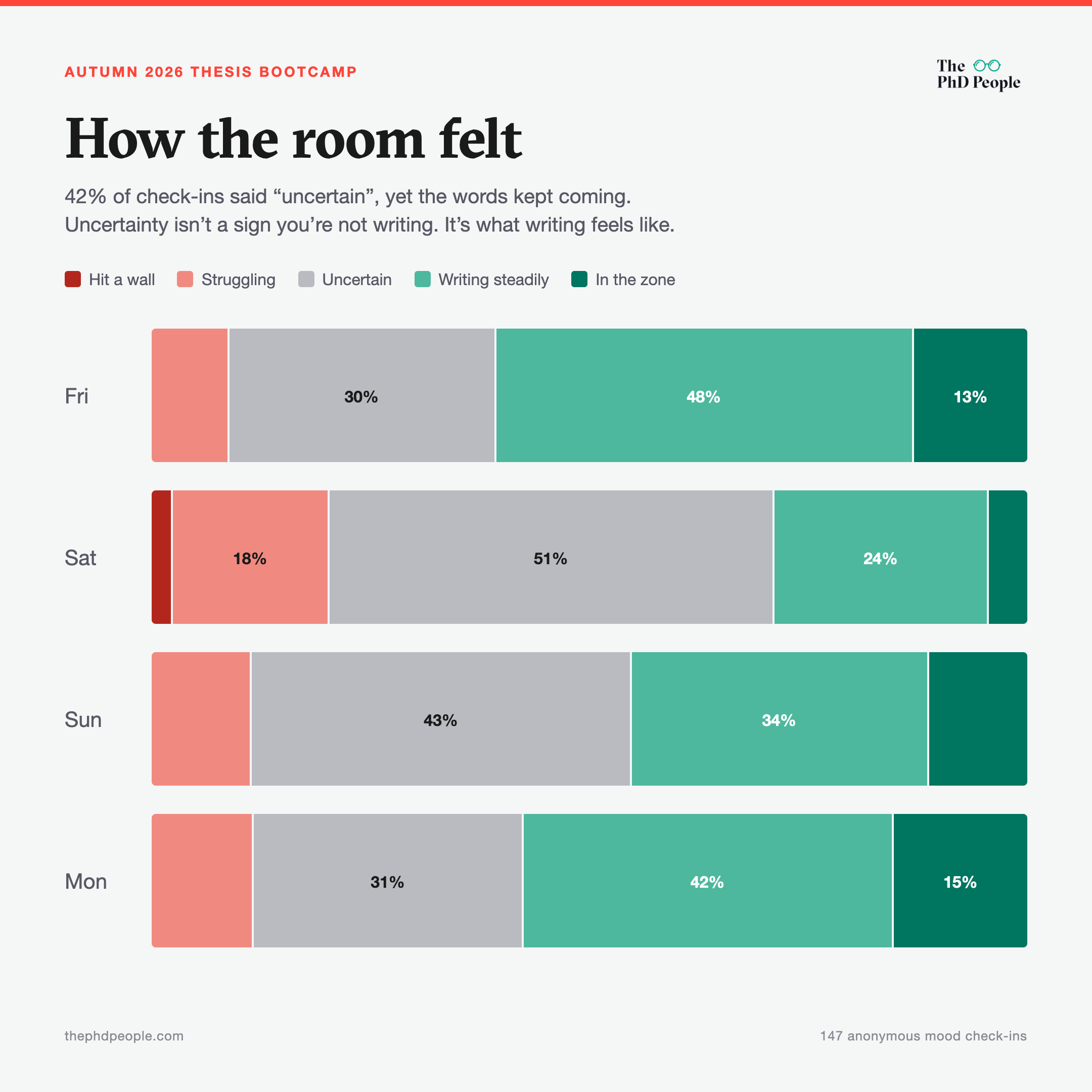
Across the four days, 42% of all check-ins said “uncertain”. In Spring and Summer it was closer to a quarter.
The anonymous feed explains a lot of it. The worries were about quality: whether the words were good enough, and whether any of it was new. Several people admitted they were avoiding the literature. One wrote, “I’m worried I’m just churning out un-usable nonsense.” Another asked for someone to tell them they had something useful to say.
Here’s the thing. Those feelings are a normal part of drafting, and most PhD researchers carry them alone. When you’re writing at home, uncertainty feels like evidence that something is wrong. In a room of 25 other people clicking the same button, it looks a lot more like what writing feels like from the inside.
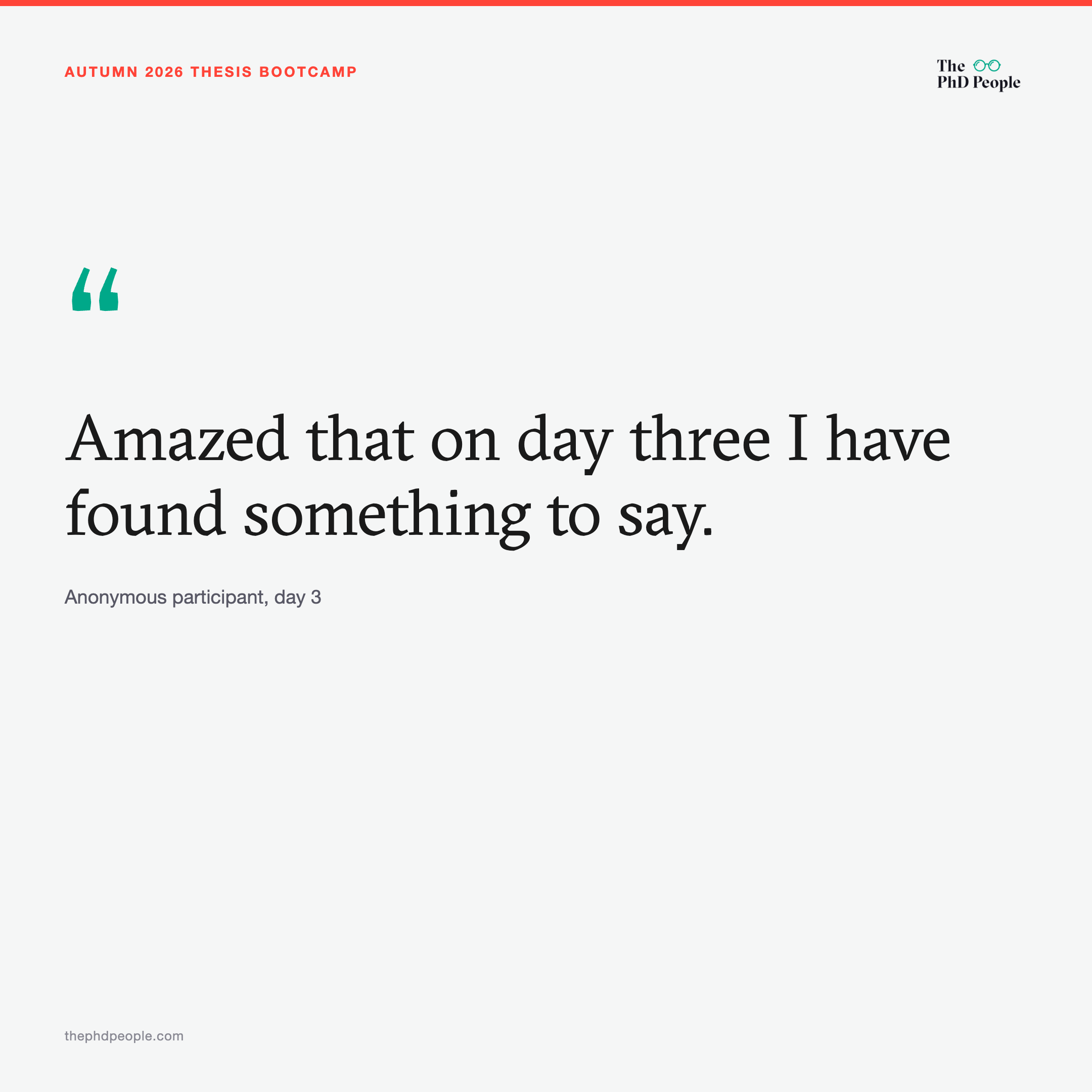
Mood recovered steadily after Saturday. By Monday, people were posting things like “I can be optimistic about the whole thing again. I feel I do know something.”
The room answered itself
The feed also turned into a conversation. There were 19 replies this time, more than either of the earlier bootcamps this year.
When someone said they felt like a fraud because AI was helping them piece ideas together, three people replied about how they use it as a critical friend. When someone worried that their word count was mostly participant quotations, another writer answered: “My word count consists of much repetition, iterations of ideas, attempts to really find out what I’m thinking. I will use only a very small amount of the words I have written but think this is a useful way to generate thoughts and voice.”
And when one person posted that they were tired but proud to have written pretty much half a chapter, the replies filled up with people saying well done.
That’s the part of a bootcamp the word count doesn’t capture. People arrive thinking they need more time to write. What they find is a room that understands.
Every writer counts
Five writers passed 20,000 words. Half wrote more than 9,096. Some wrote a few thousand, and those words count just as much.
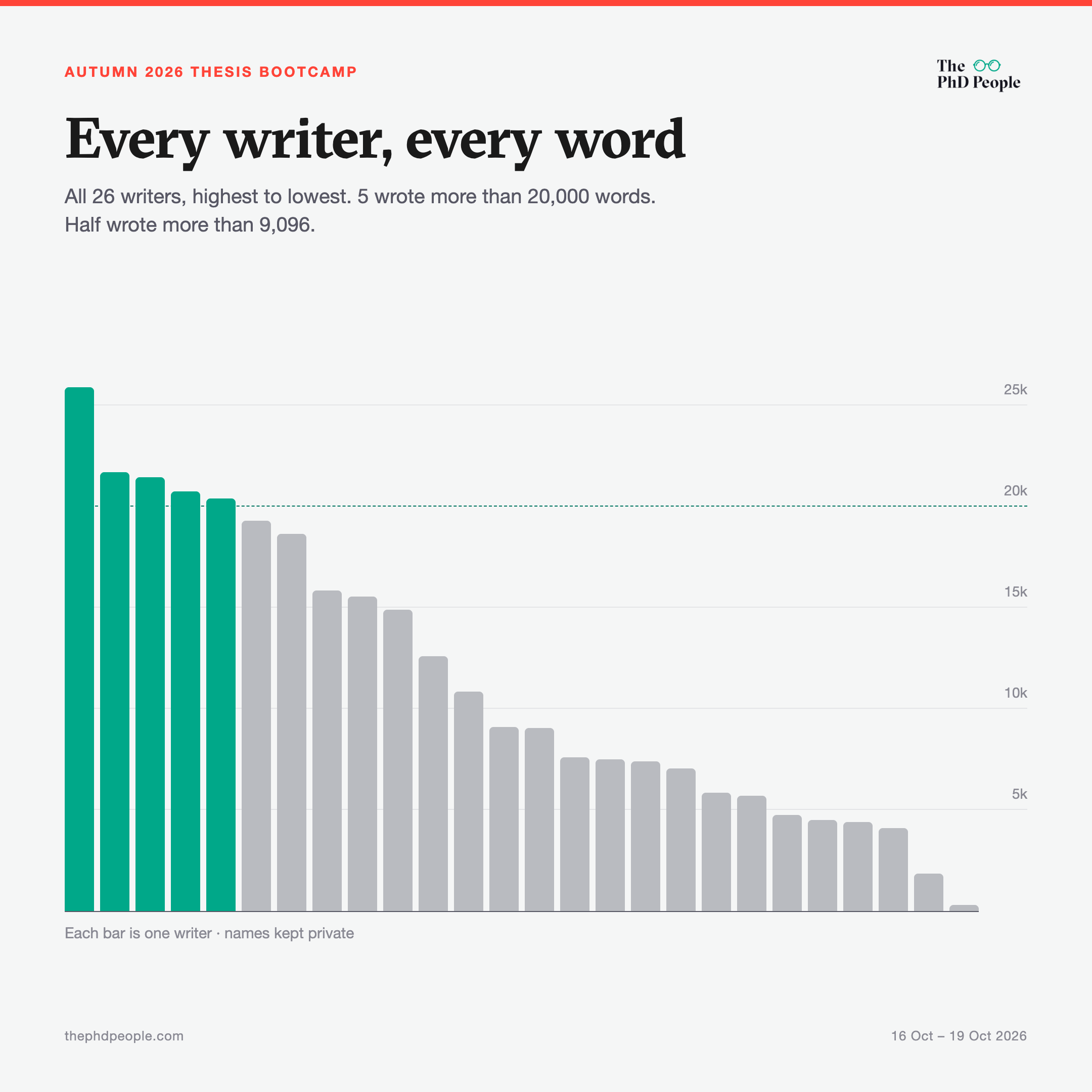
People arrive with different chapters, different weeks and very different lives. One participant spent Monday morning writing at their parents’ house on the first day of half-term, trying to ignore how long the children had been in front of the TV. Another switched to handwriting halfway through a session so they could eat with one hand and write with the other. Showing up at all is the achievement.
The next bootcamp: Winter 2027
If you’ve been writing alone this term, come and write with us in January.
The Winter Thesis Bootcamp runs live on Zoom with Professor Jane Creaton and me:
– Goal Setting & Planning Workshop: Monday 4 January, 5–6pm UK
– Writing days: Friday 15 to Monday 18 January
– Editing Workshop (optional): Monday 25 January, 5–6pm UK
Before the writing days, you’ll complete a Thesis Map so you arrive knowing exactly what you’re going to write. And if after the first writing day you decide the bootcamp isn’t for you, we’ll give you twice your money back.
Find out more and book your place
Next bootcamp · January 2027
Winter Thesis Bootcamp
Four days of live, structured writing on Zoom with around 25 other PhD researchers, hosted by Professor Jane Creaton and Dr Max Lemprière. You arrive with a Thesis Map, so you know exactly what you’re going to write.
Planning workshop
Mon 4 January
5–6pm UK
Writing days
Fri 15 – Mon 18 January
Live on Zoom
Editing workshop
Mon 25 January
Optional, 5–6pm UK
Not for you after the first writing day? We’ll give you twice your money back.




0 Comments